
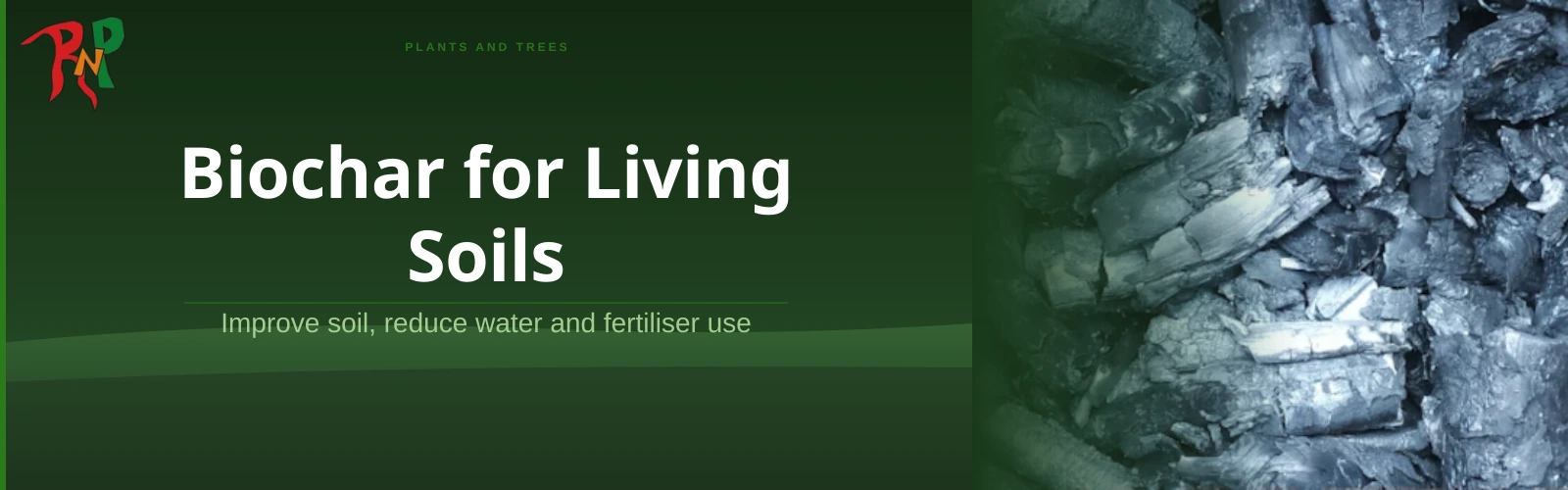
Biochar is one of the most effective soil building materials used in regenerative permaculture systems and forest gardening. When applied correctly, it can significantly reduce the need for watering and external fertilisers by improving how soil holds both moisture and nutrients while creating habitat for beneficial microorganisms.
Instead of water running straight through the soil or nutrients being washed away, biochar creates a stable porous structure that acts like a long term reservoir. This allows microorganisms to thrive while giving plants more consistent access to both water and nutrition, even in dry or poor soils.
One of the most important properties of biochar is its stability. Because it is made from carbon that has been transformed into a highly stable structure, it does not break down easily. This means it can remain in soils for thousands of years, continuing to support soil life and fertility long after most organic matter has decomposed.
In many systems this translates into healthier plants, reduced irrigation demand, and far less reliance on imported fertilisers. It is not a quick fix, but a long term shift in how soil functions.
Why Biochar Works So Well
Biochar has a highly porous structure. These microscopic spaces create ideal conditions for microbial life and also act as storage zones for water and nutrients.
- Improves soil water retention, reducing irrigation needs
- Reduces nutrient loss, lowering fertiliser demand
- Supports microbial and fungal networks in the soil
- Provides a stable carbon structure that can persist for thousands of years
- Builds long term soil fertility rather than short term input dependence
Over time, this changes the soil from something that constantly needs inputs into something that becomes increasingly self regulating.
How It Is Made
Biochar is created through pyrolysis, a process where organic material is heated with very little oxygen. This prevents full combustion and results in a stable carbon structure that can persist in soil for hundreds or even thousands of years.
Small scale production methods include simple kilns, earth mound systems, and stove based designs commonly used in permaculture contexts.
Stacking Functions in Real Design
At Roots n Permaculture, we rarely treat biochar as a single purpose output. Instead, we design systems that stack multiple functions into the same process.
Rather than producing biochar alone, we often integrate it into cook stove and heating systems so that energy and soil building happen at the same time.
These systems can:
- Cook food efficiently
- Provide space heating
- Produce hot water for household use
- Feed hydronic systems such as home radiators
- In some advanced designs, support small scale electricity generation
In one of our practical stove designs, we can cook up to five pans simultaneously on a hot plate surface, along with an integrated oven for baking. This allows a single system to replace multiple kitchen appliances while also producing biochar as a byproduct.
This approach turns waste heat and biomass into multiple useful outputs rather than a single product.
How Biochar Changes Water and Fertiliser Needs
One of the most important effects of biochar is its impact on water use. Soils improved with biochar typically require less frequent watering because moisture is held more effectively within the soil structure.
At the same time, fertiliser demand drops because nutrients are retained in the system rather than being lost through runoff or leaching. This makes growing systems more resilient and less dependent on external inputs.
In practical terms, this means less work, lower costs, and more stable plant growth over time.
Coal, Charcoal and Why They Do Not Belong in Soil
It is important to distinguish biochar from coal and general charcoal products.
Coal is a fossil fuel formed over millions of years and is not suitable for soil application. It often contains contaminants and has no role in regenerative growing systems.
Charcoal is produced mainly for fuel use and may also contain residues or properties that make it unsuitable for direct soil integration unless specifically produced for that purpose.
Biochar is intentionally produced for soil health, designed to be stable, clean, and biologically compatible with living soil systems.
Simple and Advanced Use
In practice, biochar can be added into compost systems or directly into soil as part of a wider organic system. In our teaching, we also demonstrate a much simpler method that allows biochar to be integrated without a separate preparation stage, making it easier for beginners to use effectively.
These practical details are often what make the difference between theoretical understanding and real world results.
Beyond the Basics
There are many nuances in how biochar behaves in different soils, climates and system designs. These are rarely covered in general guides and are best learned through direct experience.
In our workshops and courses, we explore these systems hands on, including design variations, stove integrations, and soil strategies that are not widely shared in public resources.
Participants often discover practical details and subtle techniques that are difficult to communicate fully in written form alone.
Courses, Workshops and Practical Training
If you are looking to attend a course, you can explore upcoming sessions below. If you are interested in hosting a workshop or organising a course in your area, this guide will help you begin preparing suitable materials in advance.
In our hands on training we go far beyond theory. You learn how to design and build systems, including integrated cook stoves, biochar production methods, and practical soil integration techniques that are difficult to fully communicate in writing.
Some of the methods and design approaches shared in these sessions are not widely published elsewhere and are demonstrated directly during the course.
Participant Feedback
"I loved the relaxed pace of the course and Rakesh’s enlightened learning strategies. I feel as if I really understand the principles of the rocket and biochar stoves, as we built both brick and metal models during our day. Rakesh is a lovely teacher. He explains everything simply and carefully and above all he is never boring!"
Making Cook Stoves
| No events |
All Other Courses
| 24 Oct 2026; 12:00PM - 04:00PM Don't throw it, lets fix it together. Repair Cafe, Goodmayes Library |
| 31 Oct 2026; 10:00AM - 05:00PM Pedal Power Generator Workshop |
| 14 Nov 2026; 09:00AM - 05:00PM Forest Gardening Intro. Growing Food, Restoring Biodiversity and Creating Thriving Ecosystems |