
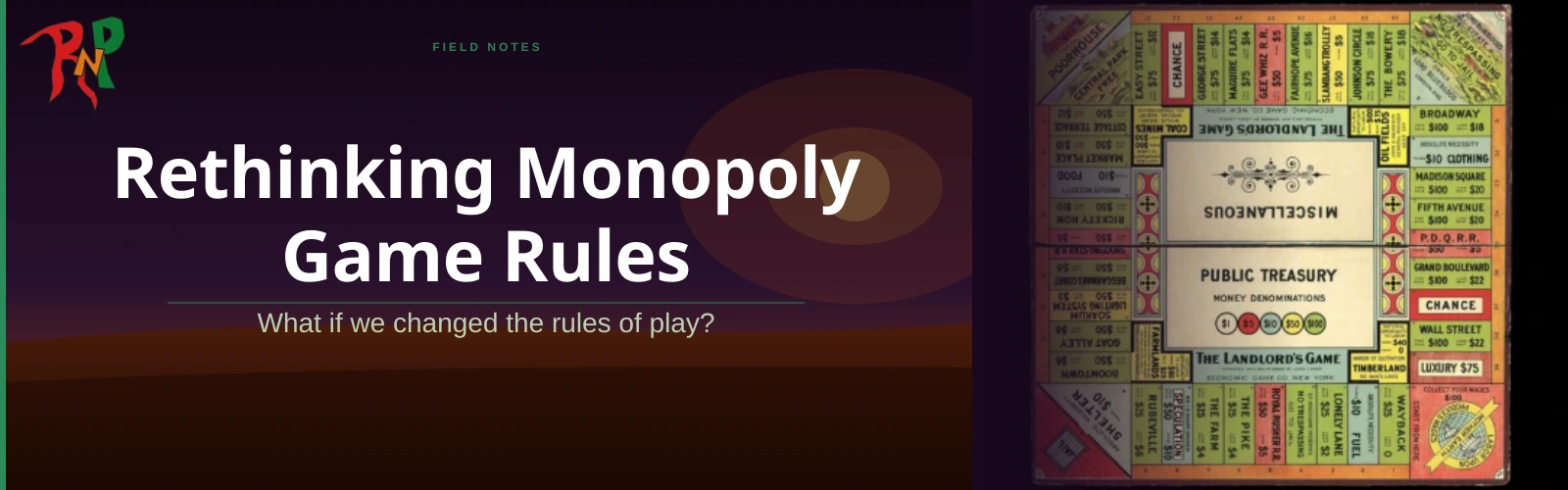
How many of us have spent an evening gathered around a Monopoly board?
The game usually follows a familiar pattern. Properties are bought. Rents rise. Wealth accumulates in fewer and fewer hands. Eventually, one player wins because everyone else has lost.
What many people do not realise is that Monopoly was originally created not to celebrate this outcome, but to question it.
The Forgotten Story Behind Monopoly
In 1903, writer, inventor and social reformer Lizzie Magie created a board game called The Landlord's Game.
Magie was influenced by the economist Henry George, who argued that while people should benefit from the value they create through their labour, land itself is a common inheritance that should benefit the wider community.
She designed The Landlord's Game as a way of helping people explore the social consequences of different approaches to land ownership and wealth.
Rather than simply teaching economic theory, she turned it into an experience that people could play, observe and discuss.
From The Landlord's Game to Monopoly
For decades, versions of Magie's game spread through communities, universities and social networks. As the game travelled, players adapted it, added local street names and created their own variations.
Then, during the Great Depression, a modified version reached Charles Darrow.
Recognising its commercial potential, Darrow refined the design and sold it to Parker Brothers under the name Monopoly.
The game became an enormous success.
Yet there was an irony at the heart of the story. The game that became famous was based on ideas developed by Lizzie Magie, but she received little recognition for her contribution.
When Parker Brothers later discovered her earlier patents, they purchased the rights for a small sum. Meanwhile, Darrow became the first board game designer to earn a million dollars.
For many years, Magie's role in creating the world's most famous property game was largely forgotten.
A Lesson in Systems Thinking
One reason this story remains relevant is that it offers a lesson in systems thinking.
Permaculture teaches us that behaviour is often shaped by design.
The outcomes we observe are rarely accidental. They emerge from the structures, incentives and rules within a system.
A board game is a simple example.
Players respond to the rules they are given.
Change the rules and different behaviours emerge.
The same principle applies to gardens, organisations, communities, economies and societies.
If a system rewards extraction, extraction tends to increase.
If a system rewards cooperation, cooperation becomes easier.
This is one reason permaculture places importance on thoughtful design.
What If We Changed the Rules?
One of the most interesting things about The Landlord's Game is that it encourages us to ask a simple question: what happens when we redesign a system?
A growing number of people have experimented with adapting modern Monopoly boards to reflect more community centred ideas.
- Rent is paid into a shared community fund rather than to individual players
- Community funds are distributed equally whenever someone passes GO
- Railways and utilities become shared infrastructure rather than private assets
- The goal shifts from individual victory to collective wellbeing
If you want to try this for yourself, a draft set of collaborative house rules is available here: Collaborative Monopoly Rules
The specific rules matter less than the experiment itself.
When the rules change, so do the behaviours and outcomes that emerge.
Anti-Monopoly: A Different Way to Play
If you would rather not invent your own house rules, there is another option.
In the 1970s, economics professor Ralph Anspach created a board game called Anti-Monopoly.
Anspach became interested in the hidden history of Lizzie Magie's work and designed a game that explores the tension between fair competition and monopoly power.
Rather than assuming monopolies are inevitable or desirable, the game invites players to examine how different economic structures affect the people within them.
Whether or not you agree with its conclusions, it offers an opportunity to explore economic ideas through play.
An Invitation to Experiment
One of the principles of permaculture is that small experiments can reveal insights.
The next time a Monopoly board comes out, you might consider trying something different.
Create a community fund. Share resources. Reward cooperation. Invent your own rules.
Observe what changes.
Every system operates according to a set of rules.
The question is not whether there are rules, but what those rules encourage.
If changing the rules of a board game transforms play, what might be possible when we rethink the rules that shape our communities, economies and relationship with land?