
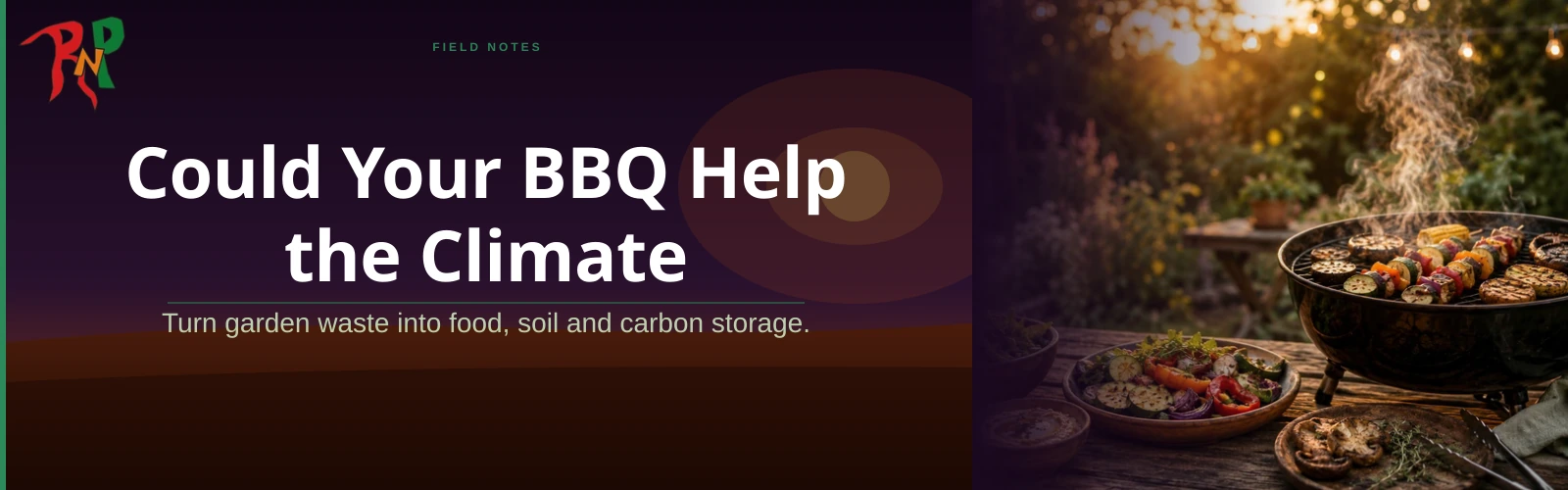
Few things feel more natural than a summer barbecue.
Friends gather in the garden. Food sizzles over glowing coals. Smoke drifts through the evening air. For many of us, it is a ritual that signals relaxation, community and the simple pleasure of cooking outdoors.
Yet hidden within this familiar scene is something most people rarely consider.
Every piece of charcoal in a barbecue represents stored carbon. As it burns, most of that carbon returns to the atmosphere as carbon dioxide. Along the way it also produces soot, smoke and fine particulate pollution.
In other words, the traditional barbecue follows a simple linear pattern.
Take a resource. Burn it. Release it.
Most people would never imagine that a backyard cookout could contribute to climate change. Yet across millions of gardens, campsites and gatherings, these emissions add up.
But what if there was another way?
What if lighting a fire to cook dinner could help keep carbon out of the atmosphere rather than add to it?
Rethinking Fire
The idea sounds counterintuitive at first.
Fire releases carbon. That is what fire does.
But combustion is not always a single process.
A growing number of gardeners, smallholders and permaculture practitioners are using a different approach called a biochar cookstove, also known as a micro gasifier or TLUD stove, short for Top Lit UpDraft.
Unlike a conventional fire, a TLUD stove is designed so that fuel is heated in a low oxygen environment rather than fully burned immediately.
Dry biomass such as twigs, hedge cuttings, nutshells, seed husks or small prunings is lit from the top. As the material heats, it undergoes pyrolysis, a process where organic matter is thermally broken down rather than fully combusted.
The biomass is effectively baked.
During this process, it releases combustible gases known as syngas. These gases rise through the stove and burn cleanly at the top, producing a hot and efficient flame.
Because these gases are burned before they escape, TLUD systems can reduce smoke and fine particulate emissions by up to 90 percent compared with open fires or conventional charcoal grills.
The result is more heat, less pollution, and far greater fuel efficiency.
What Is Left Behind
After cooking, the remaining material is not ash in the usual sense.
When the stove is carefully quenched with water, what remains is biochar, a stable form of carbon.
Instead of allowing all the carbon in the biomass to return immediately to the atmosphere, pyrolysis locks a significant portion into this solid structure. Typically, around 25 to 50 percent of the original carbon can be retained in biochar rather than released as carbon dioxide.
This changes the outcome of the burn.
Left in natural decomposition, garden waste would slowly break down, returning its carbon to the atmosphere within a few years as carbon dioxide and sometimes methane.
Biochar interrupts that pathway.
Once incorporated into soil, it becomes highly stable and can persist for hundreds or even thousands of years. For this reason, the Intergovernmental Panel on Climate Change recognises biochar systems as a form of carbon removal when managed correctly.
From Fire to Soil System
Biochar is not only about carbon storage. It is also a powerful soil building material.
Its porous structure acts as a long term habitat for soil life and a reservoir for water and nutrients.
When charged with compost, worm castings or other organic inputs, biochar can:
- Improve soil moisture retention
- Support beneficial microbial life
- Increase nutrient holding capacity
- Enhance long term soil fertility
- Improve resilience during dry periods
This creates a simple regenerative loop.
Garden prunings become fuel.
Fuel becomes cooking heat.
Cooking heat produces biochar.
Biochar improves soil health.
Healthy soil grows future food.
Waste becomes resource within a living cycle rather than an output to discard.
Looking at Everyday Materials Differently
The most important shift is often perception rather than technology.
Fallen branches, hedge trimmings and agricultural residues are commonly treated as waste streams.
In a biochar system, they become a valuable input.
This reframing is central to permaculture thinking, where function is designed into relationships between materials, energy and living systems.
For those interested in moving from concept into practice, these systems can be built and tested at small scale in gardens and community spaces.
Roots n Permaculture offers practical workshops focused on low impact cooking technologies and ecological design. These sessions are hands on, grounded in safety, and focused on real world application rather than theory alone.
Learning Opportunities
Participants are introduced to the principles behind efficient combustion and biochar production, alongside practical building experience.
One Day Biochar Cookstove Course
This workshop explores the design and construction of biochar cookstoves. Participants learn how controlled combustion can produce both efficient cooking heat and stable carbon for soil improvement.
One Day Rocket Stove Course
This workshop focuses on high efficiency combustion design. Participants build and test working models while learning core principles of airflow, heat transfer and fuel efficiency.
Who These Courses Are For
- People interested in sustainable and regenerative living
- Permaculture students and practitioners
- Community educators and project organisers
- Smallholders and growers
- Anyone interested in practical ecological technology
Closing Reflection
The next time you light a barbecue, it may be worth pausing to consider what is actually happening to the carbon in your fuel.
Is it being released as smoke and carbon dioxide, or is there a way it could be guided into soil instead?
The answer is not only technical. It is also a question of design.
Small changes in how we use fire can open up entirely different relationships between waste, energy and soil.
And in that shift lies a practical way to turn everyday cooking into a small but meaningful act of regeneration.